

 ENG▼
ENG▼
Aristocles🔗 horoscope 🔗 authorities


Platoⁱ, the Divineⁱ, Philósykosⁱ
🔗 authorities Platoⁱ, the Divineⁱ, Philósykosⁱ


Artwork
Name: Roman Copy of a bust of Plato
Author: 
Date: attr. -V
Type: Sculpture
Source: Pio-Clementino Museum in Vatican Museums 


 👁
👁


Detail

Artwork
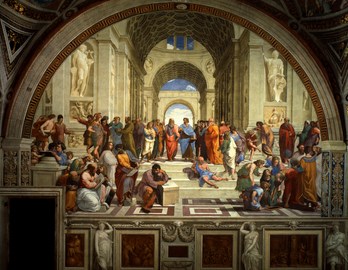
Name: The School of Athens, in the center, Plato stands to the left of Aristotle, holding the Timaeus.
Date: 1509 – 1510
Type: Fresco
Source: in Room of the Segnatura in Apostolic Palace

Artwork
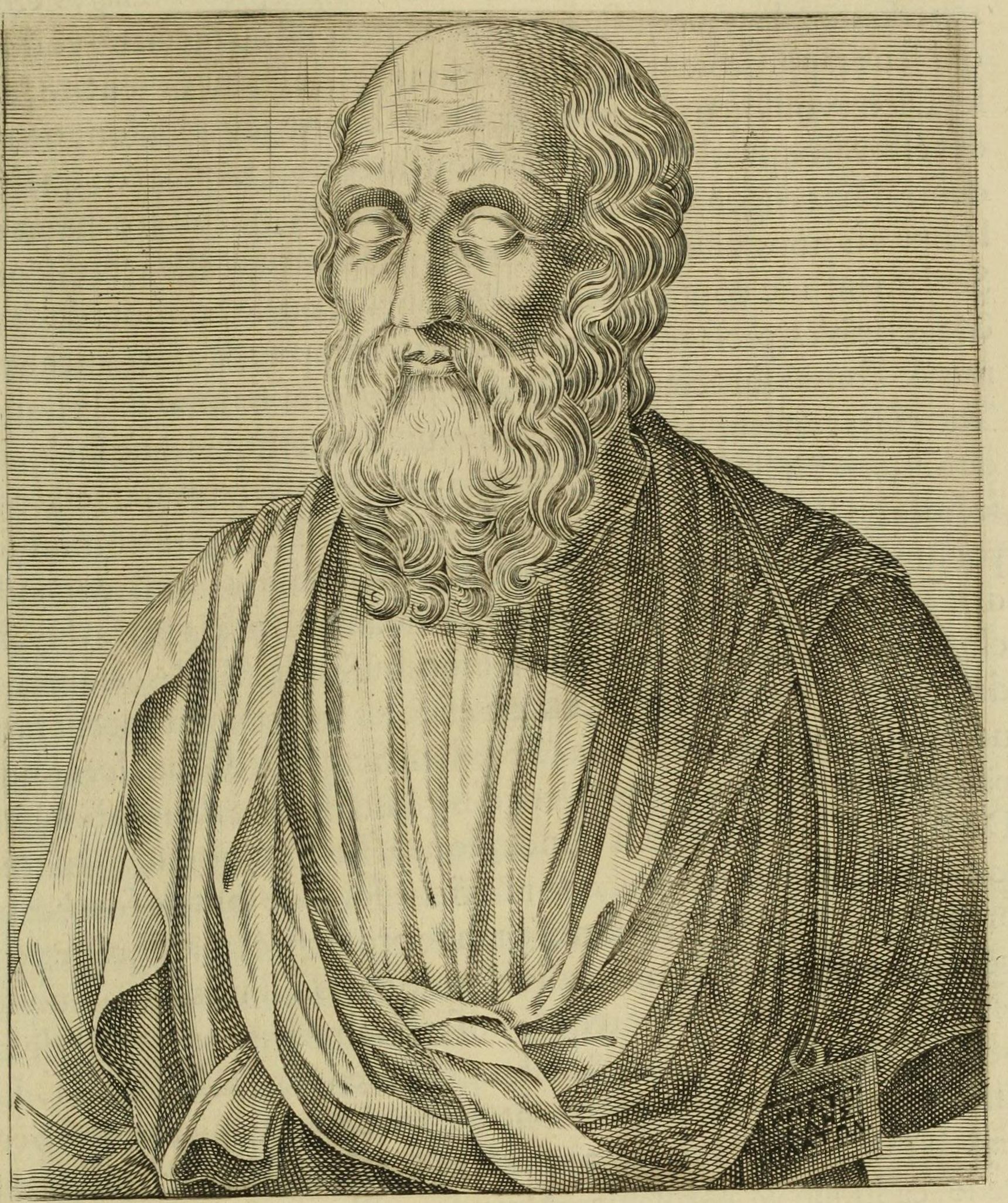
Name: Portrait of Plato
Author: Guillaume Chaudière
Date: 1584
Type: Print
Source: in The True Portraits and Lives of Illustrious Men (André Thevet) bs. Boston Public Library 

Artwork
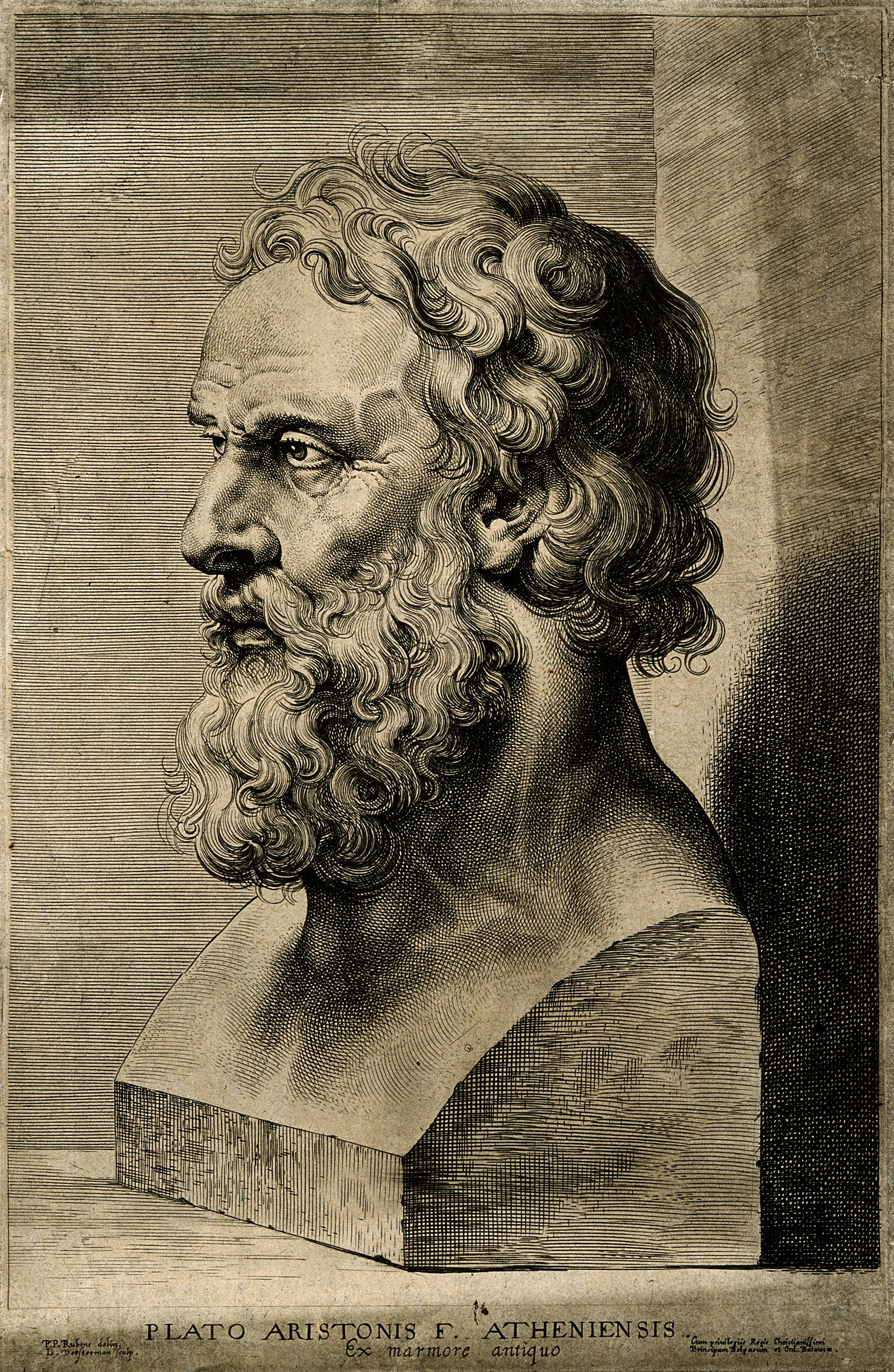
Name: Plato Aristonis F. Atheniensis
Author: Lucas Vorsterman (after Rubens)
Date: XVII
Type: Engraving
Source: Wellcome Library
 👁
👁

Alternative
Artwork
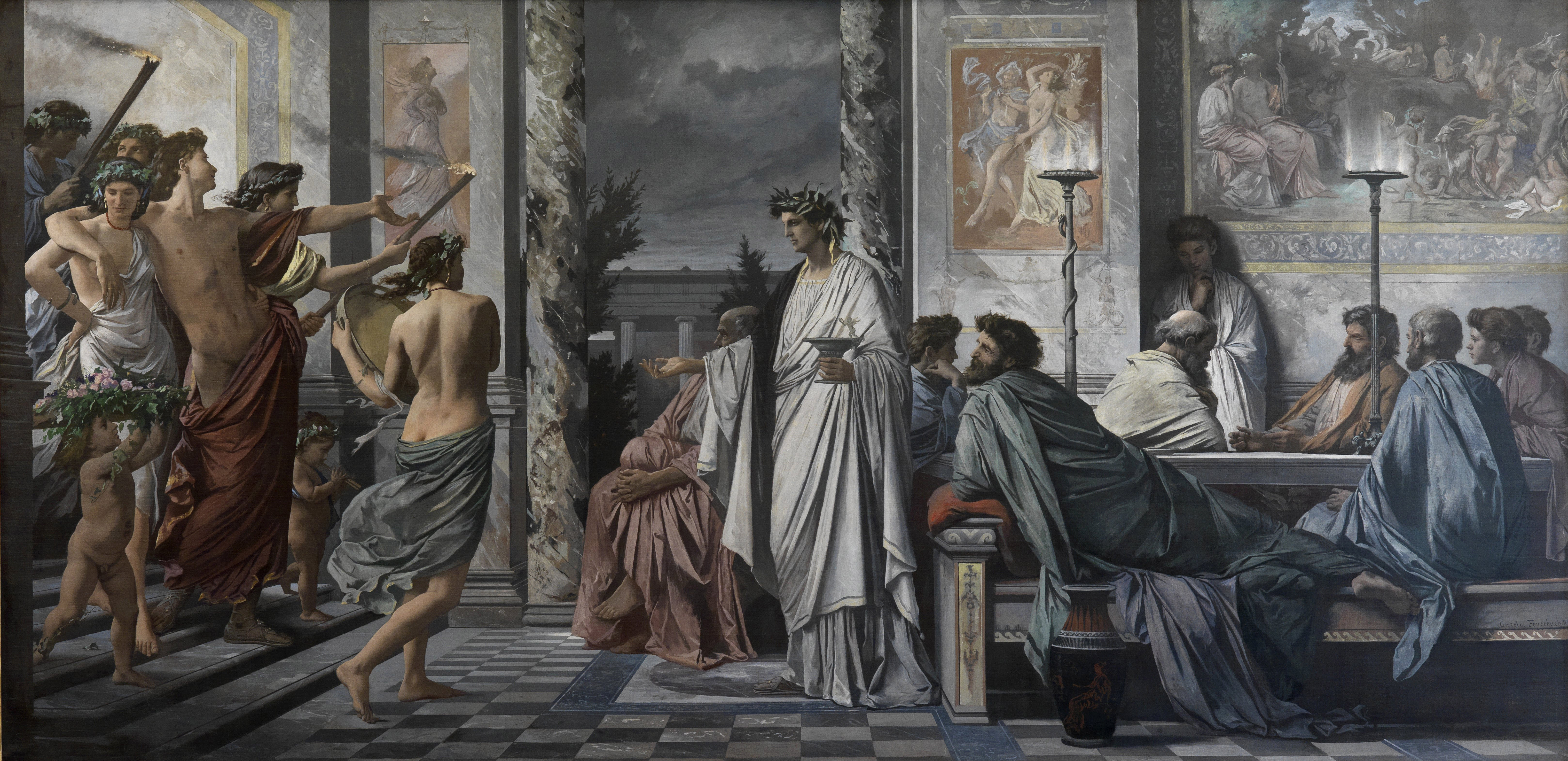
Name: Plato's Symposium (version 2 and 1)
Author: Anselm Feuerbach
Date: 1869 – 1874
Type: Oil on canvas
Source: Old National Gallery of Berlin (version 2) | National Museum of Fine Arts of Karlsruhe (version 1) 
 General Data
Identity & Period
Birth
Island of Aegina, Greece
Death
Fields & Schools
- Philosophy
- Metaphysics
- Politics
- Platonism 🎓
- Pythagoreanism
Orders & Affiliations
- The Academy 🎓
- Archytas of Tarentum
- Dion of Syracuse
- Aristotle
- Speusippus
- Western Esotericism
- Western Philosophy
- Western Theology
Biographical references
I. History
► Plato came from an aristocratic family of Athens. Aristocles is ? his real name. He received a solid education but was more specifically interested in the arts and mathematics. An athlete, his nickname "Plato" probably came from the fact that he had broad shoulders. He reportedly won prizes at athletic competitions of the time. In his youth, he was interested in politics but turned away from it, judging the parties immoral.
● As a young man, he attached himself to Socrates and became one of his principal disciples; his master would be at the center of his writings. He subsequently attempted to ally himself with the tyrants of Syracuse in order to test his political philosophy, but this was a failure for him.
● After traveling to Egypt and Sicily, he founded the Academy in Athens, a school where, in the Pythagorean tradition, he taught mathematics and argumentation to a select circle. The preferred method of seeking truth was dialectic. Speusippus would be his successor as head of the Academy. It is on its pediment that the famous Pythagorean motto is inscribed: Let no one ignorant of geometry enter here
.
■ His biography is likely embellished with legendary facts. A traveler, it was reported that he went to Egypt to be initiated into Hermeticism. He was enslaved by Dionysius the Elder, tyrant of Syracuse, but was ransomed and freed by Anniceris of Cyrene.
II. Thought
◆ Plato's doctrine is inspired by Pythagoreanism and Orphism; his philosophical approach reconciles rationality, poetry, and religiosity. For him, wisdom and piety merge: God is first demonstrated by reason, and it is then in faith that the philosopher's journey must be built. He thus takes as the basis of his approach the unification of dialectical reasoning and mathematical rationality, of initiatory love and divine delirium. In order to overcome the limitations of language, spiritual structures are designated in his work by mythical images. His practice encourages Man to reconcile his soul፧ with the good, the beautiful, and the true in a theocentric perspective where God, the measure of all things, requires from the philosopher conformity as great as possible to His being.
↳ For Plato, God is the one, being, and the good. είδος {ideas} emanate from Him, eternal and absolute spiritual forms, the principal objects of knowledge. They are the archetypes of material beings, which are transitory. This intelligible God engenders a demiurge, the intellect, who creates the world or "visible god" by taking as model the plan of ideas. This trinity, God-Demiurge-Matter, allows Plato to expound a cosmogony he considers harmonic(1), because the antagonism between the spiritual and the material is resolved by the introduction of a third term, the demiurge. Also, if God, all goodness, willed a perfect universe, necessity could only imperfectly comply with intelligence in its deployment within becoming.
↳ The Human soul, immortal, thus participates in the divine, but through the body it is partially subject to the becoming of materiality and therefore to relativity and error. Spirituality is the search for the good and therefore conformity to God; philosophy is the method of spirituality and philocalia its driving force. Matter is the receptacle of celestial influence, but if, under the effect of a contrary will, it refuses to respond to the solicitations of the intelligible and moves away from said conformity, it engenders disharmony and therefore evil. This evil, being of the material world, is nevertheless transitory. Through the awakening of ἔρως {love} uranian, which serves as motor and intermediary between body and soul, as well as through the practice of reminiscence, the soul remembers its divine origin. It can then disentangle the spiritual good from material evil. It then rises to the contemplation of ideas and finally of God.
↳ However, in his παιδεία (paideia) {pedagogy}, the soul's access to this reality must first be progressive, and the body that anchors it must move in the same proportions as the soul in order to observe an interdependent balance; otherwise anomalies emerge, undermining the soul's progress. Next, the soul must be in an environment conducive to its spiritual development, that is, harmonious, in order to arouse in the intellect it produces an instinctive attraction for the beautiful and thus toward the good, spirituality and unity, to the detriment of passions and multiplicity. Then, regarding the gods, Plato believes the wise person must know how to conciliate them, for they serve as benevolent relays of divine solicitude. It is nevertheless appropriate to purify the image that Man has of them through contact with the metaphysical rigor of the absolute. From then on, Plato becomes critical of representations fixed by poets or practices inspired by mercantile piety that distort the vision of these intermediaries and denature their function.
↳ It is under these conditions that Man will be able, in his philosophical, artistic or political activities, to produce a work that has meaning. And consequently, in his life, he will know how to fit into divine justice, favor the order of the city, and finally act in conformity with the destiny that has been set for him, by virtue of his essential magnitude. Still Pythagorean, Plato also admits for the soul metempsychosis and post-mortem retribution in order to justify the human drama as well as its resolution. He finds his lever in an intellectual and moral asceticism favoring reminiscence and his end in a progressive liberation of the soul from the bonds of matter.
III. Influence
◆ The first philosopher whose written work has come down to us almost intact, he had a permanent influence on Western philosophy and theology in general as well as a significant impact on Arab philosophy. Platonism initially generated Aristotelianism (more rationalist and descriptive) and Stoicism (more skeptical and pessimistic), each interpreting, truncating or emphasizing an aspect of his philosophy. He can be considered the first formally identified author of Western esotericism፧; Timaeus, Critias, and Letter VII are of particular interest to the esotericist, while Cratylus will attract the occultist's attention. His writings are indeed the starting point of what would later lead to Neoplatonism. This is the synthesis and redirection of the spiritualist elements of Plato, plus an Eastern contribution. This movement would be the mystical theology of aging paganism, whose theories would ultimately have a predominant influence on Western esotericism.
↳ He himself probably gave άγραφα δόγματα {unwritten teachings
}, Aristotle tells us in his Physics, but whose content and articulation are obviously difficult to reconstruct, although the exercise was attempted by Léon Robin in his Platonic Theory of Ideas  , and it seems that, influenced by Pythagoreanism, the dual aspect of myth and number(2) plays a predominant role.
↳ Taking up the vocabulary of the mysteries to which he is attached, he will formulate concepts that, based on the theory of Pythagorean numbers, propose cosmological and ontological answers that are now known to the general public:
● First, the theory of Forms and its exposition, the allegory of the cave, found mainly in The Republic and Parmenides and which, rooted in emanationism, will formalize a realism of ideas through its intelligible essences. For Plato, Man is a celestial plant
, and this divine heaven where ideas reside is his origin and his end.
● Then, in Timaeus and Epinomis, the concept of the world soul and its solids – a reinterpretation of Empedocles – as well as the myth of Atlantis and the concept of the great Year, which will both have lasting success and many developments. Plato shows there an inevitable decline of souls through a progressive exhaustion of ethical force that is concomitant with the life force.
● He will finally popularize the concepts of reminiscence (Meno and 𝕍 also Myth of Er in The Republic), maieutics (Theaetetus), and finally mysteric love (Symposium), which from Plotinus to Ficino will be restored several times in light of Platonism.
Selected works
► The attribution of some of his writings is contested by historians, while some are simply apocryphal (like the Treatise on Platonic Tetralogies from the Chemical Theatre). This list only takes into account those whose authenticity is not in doubt.
- Alcibiades Major, -IV.


- Apology of Socrates, -IV.
- Cratylus, -IV. (in Protagoras; Euthydemus; Gorgias; Menexenus )
- Critias, -IV.
- Crito, -IV.
- Euthydemus, -IV. (in Protagoras; Euthydemus; Gorgias; Menexenus )
- Gorgias, -IV. (in Works of Plato )
- Ion, -IV. (in Works of Plato )
- The Republic, -IV.
- The Symposium, -IV. (in Works of Plato )
- Lysis, -IV. (in Works of Plato )
- Menexenus, -IV. (in Protagoras; Euthydemus; Gorgias; Menexenus )
- Meno, -IV. (in Protagoras; Euthydemus; Gorgias; Menexenus )
- Parmenides, -IV. (in Theaetetus; Parmenides )
- Phaedo, -IV.
- Phaedrus, -IV. (in Works of Plato )
- Protagoras, -IV. (in Works of Plato )
- Theaetetus, -IV. (in Theaetetus; Parmenides )
- Timaeus, -IV.
Quotes
It is not death that must be feared, but a life spent in injustice, for it would be the greatest of misfortunes to descend to Hades with a conscience swollen with crimes.
But I believe that such teachings are suitable only for the small number of people who, with initial indications, know how to discover the truth themselves. As for the others, it would only inspire in them a vexing contempt, or fill them with vain and proud confidence that they have acquired the most sublime knowledge. I want to dwell further on this subject, and what I have just told you will seem clearer. Indeed, there is a reason that restrains the temerity of those who wish to write about any of these matters: this reason I have often expounded, and, it seems to me, it must be repeated again. There are in every being three things that are the conditions of knowledge: in fourth place comes knowledge itself, and in fifth place we must put what is to be known, the truth. The first thing is the name, the second the definition, the third the image; knowledge is the fourth.
But what is the conduct pleasing to God? Only one, based on this ancient principle, that like pleases like when both are in the just middle; for all things that depart from this middle can neither please each other, nor those that do not depart from it. Now God is for us the just measure of all things, much more than any man can be, as is claimed. God being thus, there is no other means of making oneself loved by Him than to work with all one's power to be thus oneself. Following this principle, the temperate man is a friend of God, because he resembles Him; on the contrary, the intemperate man, far from resembling Him, is entirely opposed to Him; and thereby he is unjust. The same must be said of the other virtues and other vices. This principle leads us to another, the most beautiful and truest of all: namely, that on the part of the virtuous man, it is a praiseworthy action, excellent, which contributes infinitely to the happiness of his life, and which is completely in order, to make sacrifices to the Gods, and to communicate with them through prayers, offerings and assiduous worship; but that with regard to the wicked, it is quite the contrary, because the soul of the wicked is impure, whereas that of the just is pure. Now it is not fitting for a good man, still less for God, to receive gifts presented to him by a hand soiled with crimes. All the care that the wicked take to win the goodwill of the Gods is therefore useless, while those of the just man are favorably received. This is the goal at which we must aim.
[…] of all victories the first and most beautiful is the one won over oneself, just as of all defeats the most shameful and most fatal is to be defeated by oneself. This means that there is in each of us an enemy of ourselves.
If one is, can it be without participating in being? Must we not recognize the being of one as not being the same thing as one? For otherwise, it would not be its being, and one would not participate in it; but it would be about the same thing as saying: one is, or one one. Now, what we have proposed is to investigate what will happen, not in the hypothesis of the unity of one, but in that of the existence of one. Is it not true? […] Thus, we want to say that is signifies something other than one. […] To say that one is, is therefore to say in abbreviation that one participates in being? […] Let us therefore say once more what will happen if one is. Examine whether from our hypothesis thus established it does not follow that being is a thing that has parts. […] If is is is said of the one that is, and one of the one being, and if being and one are not the same thing, but both belong equally to this thing that we have supposed, I mean the one that is, must we not recognize in this one that is, a whole, of which one and being are the parts? […] Shall we call each of these two parts simply a part, or rather must not the part be said the part of a whole? […] And a whole is what is one and has parts. […] But what! these two parts of the one that is, one and being, do they ever separate from each other, one from being or being from one? […] Thus each of the two parts still contains the other, and the smallest part, being or one, is composed of two parts. We can always continue the same reasoning; whatever part we take, it always contains, for the same reason, the two parts: one always contains being, and being always contains one, so that each is always two and never one. […] In this way, the one that is would be an infinite multitude? […]
It seems indeed that what you say about knowledge is not a trivial thing (Knowledge is sensation); this is what Protagoras himself said about it. He defined it as you do, but in different terms. He says indeed, does he not, that man is the measure of all things, of the existence of those that exist and of the non-existence of those that do not exist. […] would he not have spoken in riddles for the crowd and the common people that we are, while to his disciples he told the truth in secret? […] I will tell you (What I mean by this), and it is not an insignificant thing: it is that no thing, taken in itself, is one, that there is nothing that can be named or qualified in any way with justification. If you designate a thing as large, it will also appear small, and light, if you call it heavy, and so on with the rest, because nothing is one, nor determined, nor qualified in any way whatsoever, and it is from translation, movement and their reciprocal mixture that are formed all the things we say exist, using an improper expression, [152e] since nothing is ever and everything is always becoming. All the wise men, one after another, with the exception of Parmenides, agree on this point: Protagoras, Heraclitus and Empedocles, and among the poets, the most eminent in each genre of poetry, in comedy Epicharmus, in tragedy Homer. When he says: "Ocean is the origin of the gods and Tethys is their mother," he says that everything is the product of flux and movement. Is it not, in your opinion, what he wanted to say?
[…] For it is the true mark of a philosopher, the feeling of wonder that you experience. Philosophy, indeed, has no other origin, and he who made Iris the daughter of Thaumas is not, it seems to me, a bad genealogist. […]
We have often repeated that there are in us three kinds of souls that inhabit three different places, and each of which has its separate movements. We must now say likewise in a few words that if one of them remains idle and surrenders to rest instead of moving, it necessarily becomes the weakest, while those that exercise themselves become strong. We must therefore take care to exercise them all with harmony. As for that of our souls which is the most powerful in us, here is what must be thought of it: it is that God has given it to each of us as a genius; we say that it inhabits the highest place of our body, because we rightly think that it raises us from earth toward heaven, our homeland, for we are a plant of heaven and not of earth. God, by raising our head, and what is for us like the root of our being, toward the place where the soul was originally engendered, thus directs the whole body. He who surrenders to passions and quarrels, and occupies himself with cares of this kind, necessarily has only mortal thoughts, and must become mortal as much as possible: he can lack nothing in this, since he himself has taken pleasure in increasing the mortal part of his being. But he who has turned his thoughts toward the love of knowledge and the love of truth, and who has directed all his forces in this direction, must necessarily, if he attains the truth, think of immortal and divine things; and as much as it is given to human nature to obtain immortality, he lacks nothing to be immortal; and since he has always cultivated the divine part of himself and honored the genius that resides in him, he enjoys the sovereign good. Moreover, we all have only one means to cultivate all parts of ourselves, it is to give to each the movements and revolutions that are proper to it. Now what is divine in us is of the same nature as the movements and circles of the world soul. Each of us must therefore, following the example of these circles, correct the movements that are disordered in our head from their very origin, by penetrating with the harmony and movement of the universe; that he render the mind that conceives conformable to the conceived object, as this should have been in the primitive state, and that through this conformity he be in possession of the most excellent life that the gods have granted to man for the present and for the future.
Yes, Socrates; every reasonably sensible person implores divine assistance before beginning any undertaking whatsoever, large or small. All the more so, we who have undertaken to explain the universe, what is its origin, or if it has none; unless we want to go astray, we must pray to the gods and goddesses to put into our mouths things that are pleasing to them above all and then to you. Let us still implore the help of the gods, so that you easily understand what I have to tell you, and that I myself clearly explain my thought to you. In my opinion, we must begin by determining the following two things: What is it that exists at all times without having taken birth, and what is it that is born and reborn ceaselessly without ever existing? One, which is always the same, is understood by thought and produces rational knowledge; the other, which is born and perishes without ever really existing, falls under the grasp of the senses and not of intelligence, and produces only an opinion. Now, everything that is born necessarily proceeds from a cause; for nothing of what is born can be born without a cause. The artist, who, his eye always fixed on immutable being and using such a model, reproduces its idea and virtue, cannot fail to give birth to a whole of accomplished beauty, while one who has his eye fixed on what passes, with this perishable model, will make nothing beautiful. As for the universe, whether we call it heaven or world or by any other name, we must first, as for any thing in general, consider whether it exists at all times, having no beginning, or whether it was born and has a beginning. The world was born; for it is visible, tangible and corporeal. These are sensible qualities; everything that is sensible, falling under the senses and opinion, is born and perishes, we have seen it; and everything that is born must necessarily, we say, come from some cause. But it is difficult to find the author and father of the universe, and impossible, after having found him, to make him known to everyone. Moreover, we must know which of the two models the author of the universe followed, whether it is the immutable and always identical model, or whether it is the model that began. If the world is beautiful and if he who made it is excellent, he obviously made it from an eternal model; otherwise (which it is not even permitted to say) he used the perishable model. It is perfectly clear that he used the eternal model; for the world is the most beautiful of things that have a beginning, and its author the best of all causes. The world was therefore formed from an intelligible, rational and always identical model; whence it follows, by a necessary consequence, that the world is a copy.
Beware of giving children the nourishment of studies by force, but let it be by mixing it with their games, in order to be even more capable of perceiving what the natural inclinations of each are.
Most people do not reflect on what presents itself to them and, even once instructed, they do not understand: they live in appearance.
Version: 1.5
Upd : 04/07/2026 (eng.ver: November 05, 2025)